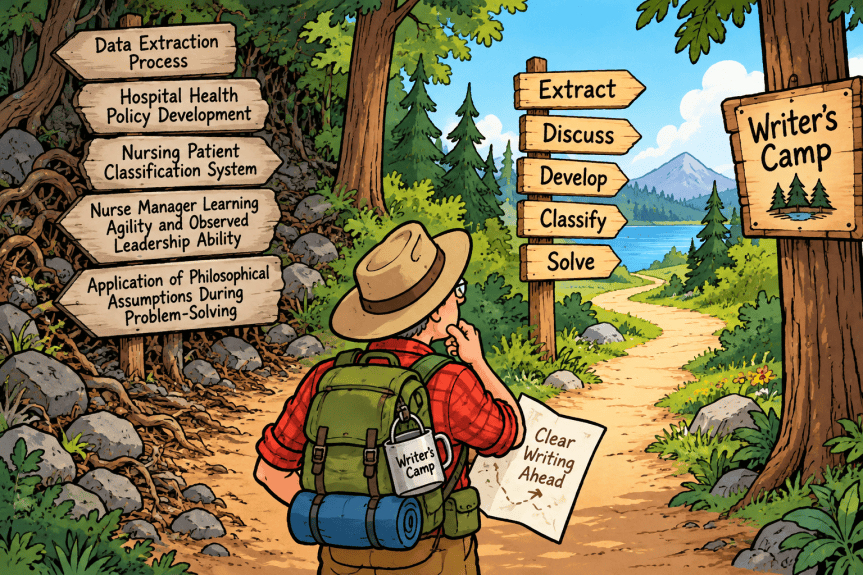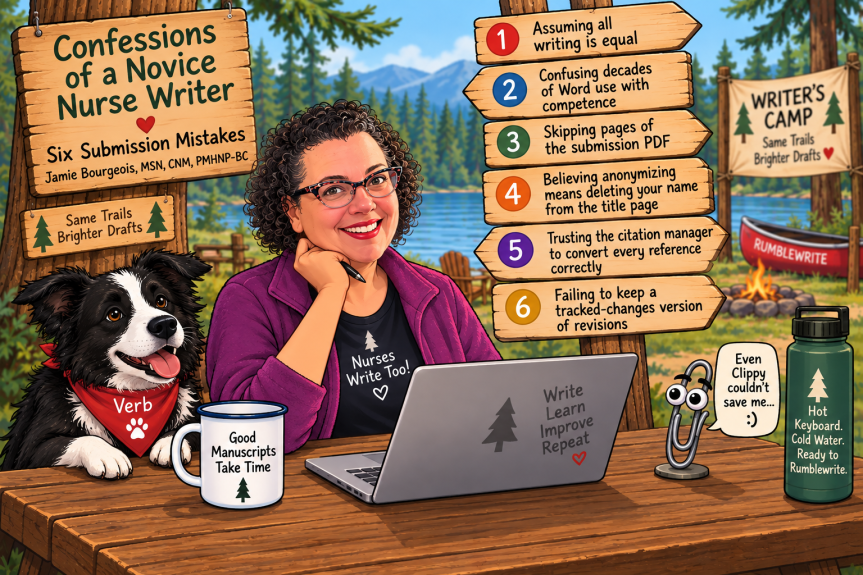
Welcome to Writer’s Camp!

I am delighted that you have found your way to Writer's Camp, a community that celebrates excellence in writing, editing, and publishing. While we emphasize these skills for nursologists, everyone is welcome. Take a few minutes to see what we have to offer.

You can be a learner, or if you are so inclined, you can write for Writer's Camp. Bookmark the site and visit it often — there's something new almost every day. I am glad you are here!
—Leslie H. Nicoll, Camp Director

How to Read Like a Scholar (Without Drowning)

Leslie H. Nicoll emphasizes the importance of purposeful reading for scholars to manage overwhelming reading loads. By defining clear goals, adapting reading speeds, and knowing when to stop, academics can engage with literature effectively. Nicoll advocates for maintaining pleasure reading to enhance overall comprehension and joy in the reading process.

Trail Pack: From One Minute to Five: Designing a Collaborative Writing Assessment That Works

The content introduces the Five-Minute Peer Writing Activity (FMPWA) developed by Andrew Richards to enhance nursing students' engagement and learning. This collaborative assessment replaces the traditional one-minute paper, fostering effective peer feedback and improving understanding. Research shows significant increases in student satisfaction and performance, affirming its adaptability in educational settings.

Email Etiquette for Authors: Editor Irks, Super Irks, and How to Avoid Them

Annie J. Rohan and Leslie H. Nicoll present essential guidelines for professional email etiquette aimed at authors communicating with editors. They emphasize that emails should be clear, respectful, and appropriately formatted, with the correct use of salutations and avoiding casual language, such as emojis and textisms. Authors should be mindful of their relationship with editors, addressing them formally unless invited otherwise, and carefully considering the content and tone of their messages. Key "editor irks" identified include using generic salutations, improper journal names, and marking emails as high importance. Overall, professional email habits reflect one's reputation and respect for the recipient.

Don’t Hate on the Percolate

Drs. Jenny Chicca and Teresa Shellenbarger compare writing to coffee brewing methods, emphasizing the importance of percolation. While Chicca favors quick writing, Shellenbarger believes in allowing ideas to develop over time. They discuss how percolation enhances creativity and organization, encouraging writers to take their time and refine their thoughts for better outcomes.

Writing Retreats Your Way

Jayne Jennings Dunlap and Julee Briscoe Waldrop emphasize the adaptability of writing retreats, detailing their experience with a virtual retreat due to unforeseen circumstances. They highlight the importance of dedicated time for writing, whether solo or group-based, and encourage readers to envision their own dream retreats to enhance creativity and productivity.

Writing a Column for a Nursology Journal: A Personal Experience

Jacqueline Fawcett reflects on her journey with HumanBecoming Theory and her writing experience for Nursing Science Quarterly, initially influenced by Rosemarie Rizzo Parse. She emphasizes the significance of precise language in nursing discourse and shares insights on collaborating with colleagues and the meaningful engagement with nursing's metaparadigm in her columns.

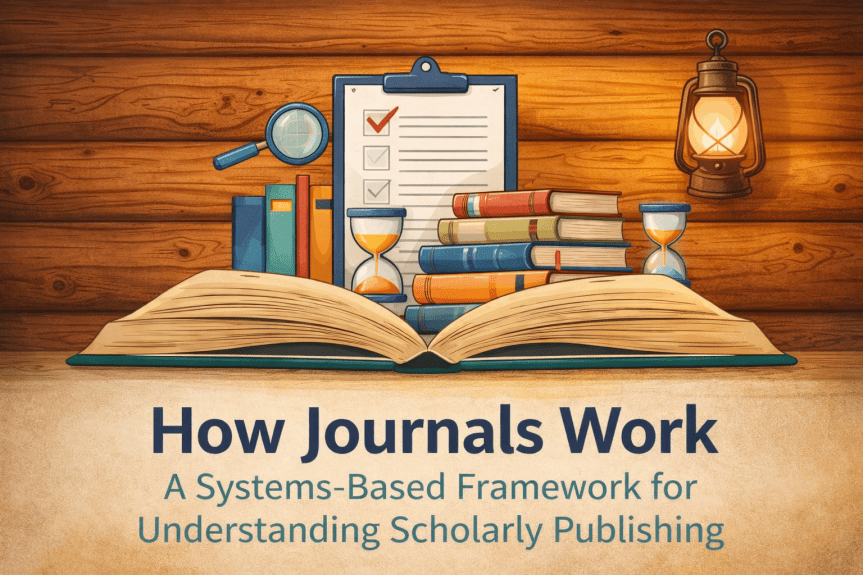
How Journals Work: A Systems-Based Framework for Understanding Scholarly Publishing

Scholarly journals are often judged by prestige or impact, yet these signals reveal little about how journals actually function. The Journal Systems Framework offers a systems-based way to understand differences in editorial intent, capacity, infrastructure, and governance—helping authors, editors, and institutions move beyond simplistic labels toward clearer, more informed conversations about publishing.

Journals as Systems: Rethinking How Scholarly Publishing Works

Leslie H. Nicoll discusses the complexities of scholarly journal publishing, emphasizing the need to view journals as systems rather than mere labels like “predatory” or “legitimate.” This perspective fosters more meaningful conversations about journal operations and integrity, ultimately promoting a clearer understanding of their diverse functions within scholarly communication. The upcoming Journal Systems Framework will facilitate this approach.

Misuse of Methods in Academic Publishing: A Growing Concern

Editors Roger Watson and Mark Hayter highlight the troubling trend of method misuse in nursing research. Many complex studies lack theoretical foundations and meaningful contributions, driven by a "publish or perish" mentality. They urge a focus on substantive research questions and propose education reform for editors, reviewers, and academic leaders to combat this issue.